

In
mid-July, my high school classmates (PWU, Taft Ave., Manila) invited me to go
to Palawan. I immediately said yes
because it is my dream to see this clean and green place. Our classmate, Dra. Grace, an OB Gyne, who is
based there arranged for our hotel and tour.
I travel
light. I travel green with my herbal and
herbs. I brought with me small quantities
of my homemade toiletries such as Gugo Shampoo,
Aloe Vera Rinse, Aloe Sanitizer,
Citronella-Mint oil/Mosquito Repellant,
and Citronella-Mint Deodorant. (Check
out How to Make Gugo Shampoo, The Versatile Citronella, Aloe Vera: The Added Value, and Herbal and Herbs in Personal Care: Aloe Vera, Mints & Citronella).
For food, I prepared a sandwich made of
homemade tuna belly with mushroom and carrots in olive oil mixed with Basil,
Oregano, Kuchai Leek, and Ashitaba. I also brought fresh Ashitaba leaves since
it is good for the immune system, respiratory and digestive systems. And for
drink, I brought some dried Tarrragon leaves. I placed these leaves in my water
container for calmness and sweet taste.
(Check out Ashitaba & The Other Angelica Herbals All Over The World
and Herbal Tea & Juice).
In August
8, 2013, my classmates Lily Jane (from
California), Regie, Rose and I took the plane to Palawan. Our hostess welcomed us with gifts!

As soon as
we reached the hotel, Lily Jane and I decided to contract a tricycle to bring
us to the churches. Boyet, the driver,
was like a tourist guide showing to us important spots. He was also our cameraman, and seemed amused
to see two matured women acting like high school girls.

First, we went to Immaculate Concepcion Cathedral. Right beside it is the American POW Memorial and Garden. The Americans were imprisoned there and burned to death during the Japanese occupation.

We also went to the Iglesia ni Kristo Church, and finally, to the San Miguel Arkangel Church located behind our hotel.
First, we went to Immaculate Concepcion Cathedral. Right beside it is the American POW Memorial and Garden. The Americans were imprisoned there and burned to death during the Japanese occupation.
We also went to the Iglesia ni Kristo Church, and finally, to the San Miguel Arkangel Church located behind our hotel.
In our short
trip, I did not see anyone smoking nor did I see any wrapper, paper,
plastic nor cigarette butts on the
streets.
For dinner,
we went to a well-known restaurant serving authentic Vietnamese cuisine. The place is just a simple hut. They served us their version of lumpia (eggroll
with vegetables) and another type filled with vegetable and shrimps. They also served us their own dried rice
noodles (I thought these were coconut shreds) with togue (mungbean sprouts),
cucumber, Java Mint and Beef. It did not have soup no sauce, just vinegar with garlic to add more flavor. (Side note: When I got
home, I also tried my own version.
Instead of Vietnamese rice noodles, which is not available in my
kitchen, I used sotanghon. My family
liked the authentic taste with Java Mint included. A discovery!)

The next
day, we went to one of The Seven Wonders of the World known as the Underground
River. It is located at Cabayungay,
Sabang, which is more or less two hours away from the city. Along the way, the mountains were verdant
with tall trees showing how cooperative the Palawenos are with nature. I can only hope other provinces would do
same.


The sand in
Sabang pier is fine and colored cream and it felt so good to go barefoot. We
rode a motor boat over the South China Sea.
The smooth rhythm of the sea waves together with the gentle wind was
like a natural massage.

At the Underground River Park, there is a
monkey that enjoyed posing for pictures.
But we were warned not to bring out
any food. Any smell of food or
sound of plastic might attract a troop 20 to 40 monkeys


We walked
through a wooden path surrounded with big trees. Some of these are:
1. Ipil Tree (Fabacea Intsia Biyuga) - This has bigger leaves compared to the
Ipil-Ipil.
2. Pahutan (Mereangifera Altissima
Blanco) - This is the food of the monkeys.
The fruit of this tree is a mango variant, which is edible but not
popular to residents because of its medicine-like taste.
3. Bitanog/Dangkalam (Catophyllum
Inophyllum Guttiferaea) – A huge tree as seen below.

We also saw
a small crocodile-like animal. Actually,
it is a Monitor Lizard or Bayawak (Varonus Salvator) which is common at the
park. These are endangered species scavenging for mammals, birds, eggs, fruits, etc.
The largest size Is 2 meters.

It drizzled
as we entered the cave of the Underground River.

Water
continuously fell from the roof of the cave but all passengers are provided
with hard hats and life vests. Our Boat Captain, who calls himself “Joy to the
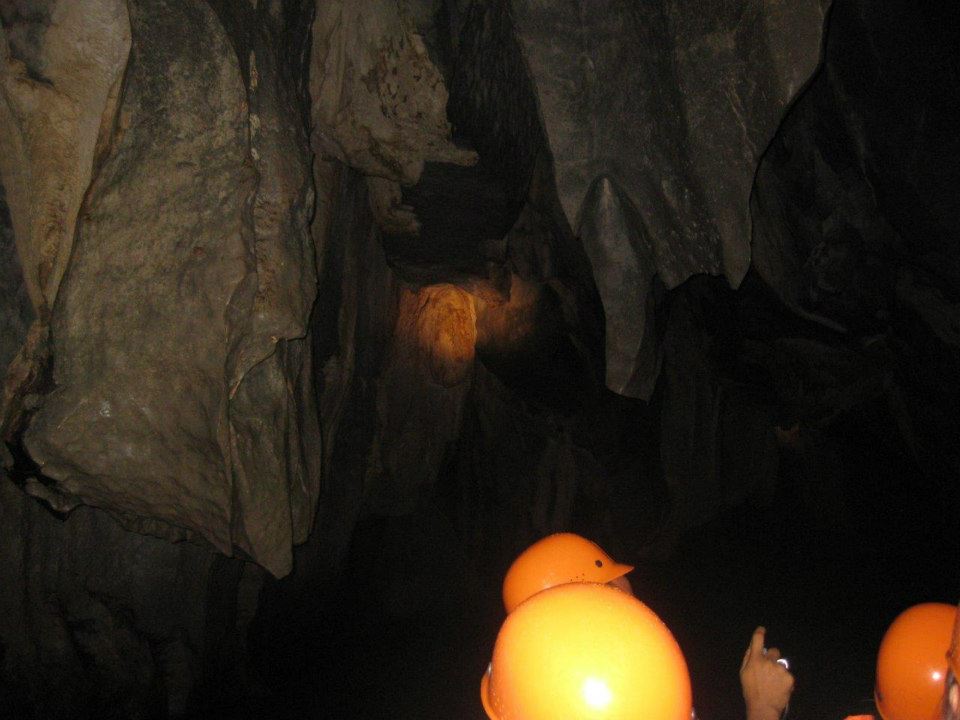
World,” is also our humorous tourist guide. As we entered, we saw stalactites
hanging downwards from the roof of the cave.
These lime rock formations grow at 0.2 meters per year.
It was dark
inside but we had a male volunteer holding the flashlight focusing on the
creative formations. Inside the
enchanting cave, there is what they call The
Cathedral, which has a big candle-like stalagmite that stands at the
entrance. There were rocks forming many
images like The Holy Family, angels,
saints, and church-like structures. They have rock formations that looks like
corn, vegetables, garlic, onions, bread
and many more, which they call Supermarket. There were also formations like a music bar,
a sexy woman and more to the imagination.



We noticed
there are writings on the wall by American soldiers. They were the brave soldiers who explored the
cave when natives believed there were evil spirits inside. It was only in 1971
when the authorities decided to appreciate its great wonder.
There are
also 100,000 bats and swallows that inhabit the underground river. They
peacefully co-exist since swallows wake and make their Nido bird’s nests during
the day while bats work at night.

Our next
destination was the Ugong Rock, where
a cave of stalactites and stalagmites can be touched. At the end of this cave
is a zip line. They call it
spelunking. Our tour companions, Liza
and her family (from LA) and Faif (from Singapore) did the spelunking while we
cheered.
That night,
we had a sumptuous dinner at a seafood restaurant called Ugong Rock with Dr. Grace.
Her husband, Ed, just joined us for picture-taking.


The next
day, we went shopping for pearl necklaces and bracelets, toys, kasuy (cashew),
and many delicacies! Palawan is noted
for pearls such as expensive South Sea Pearls, Fresh Water pearls and cultured
Mikimoto pearls.

On our
final day, we went to the Mitra Farm,
where there are horses, cows, zip line and an organic vegetable farm. We also visited Baker’s Hill, which sells crinkles, kasuy, hopia, and
delicacies. There were stores selling
pizza, banana cue, fruit juices and a restaurant where we had halo-halo (boiled
banana, milk, crushed ice and custard and more) as well. The place has many
flower decorations and a refreshing
garden, where visitors take turns to pose for pictures.


We were,
indeed, blessed with good weather.
Special thanks to the prayers of the Sisters
of the Augustinian Recollect and Scuola
Figlie di Maria Immacolata of Paranaque, and churchmates. Even our flight
with Philippine Air Lines was wonderful with its famous soft landing!
Finally, I was
able to capture a part of the world-renown, Palawan - may this wonder-of-a-place
together with its responsible and environment-friendly people, be our
inspiration.
*Photos courtesy of Lily Jane Makanas-Pacheco


