halamang gamot

HOLYBASIL (TULSI) – THE AIR PURIFIER, ENERGIZER, STRESS BALANCER, BEAUTIFIER

3:38 AM


Holy Basil is also known as Tulsi. This herb was discovered more than 3,000 years ago in India, where the plant was used for worship by the Vaishavitic traditions of Hinduism.  In the ancient times, it was also used in Greece and Rome.  It is scientifically known as Ocimum Sanctum or Ocimum Tenuiflorum belonging to the Lamiceae family.

This herb is grows in Asia, England, United States, Brazil, and Africa where it has different names like Basilic Saint, Basili Sacre and many more.

Holy Basil is related to Basil scientifically called Ocimum and the ‘Thai Basil’ known as Ocimum Basilicum.

Tulsi is also called ‘incomparable one’ because of it medicinal and herbal value such as:

      1.   Air Purifier and Energizer – Tulsi releases a special kind of essential oil which frees the air from bacteria and substances that cause diseases.  It also releases ozone which contains 3 atoms of Oxygen (O3) compared to the atmospheric Oxygen that produces 2 atoms of Oxygen (O2) per molecule.  These are the findings of a study at S. V. University, Trupati, India, as reported in the issue of ‘Gujarat Samachar’ dated March 25, 1988.


Get your Holy Basil at https://herbalandherbs.wordpress.com/ at Php60-80/seedling bag.

These properties of Tulsi give great energy to the lungs.

Outdoors, this herb releases essential oil and ozone (O3) reaching up to 200 meters away.  Its electrical energy keeps the air fresh.  To care for this plant, it is important to keep it moist and exposed to the sun daily. Once these requirements are met, some pots can be placed indoors for the family’s protection from pollution and diseases.  At night, it should be brought outside for overnight exposure.  I do this at home.

       2.       Stress Balancer – Tulsi contains a compound called Adaptogen which is associated with mental clarity.   When stress occurs, the response from the body is to’ fight or flight’.  Then, adrenaline glands automatically produce stress hormones. With the presence of Adaptogen in Tulsi, the hormone level of Corticosterone is lowered to help balance the stressful situation. 

Drinking of Tulsi decoction (boiled) or chewing fresh leaves daily relieves mental stress according to Dr. Narendra Singh, Assistant Director of Pharmacology in King George Medical College, Lucknow, India.

       3.       Beautifier – Some of the easy ways to use this herb are:

To have a clear skin:  In sitting position, inhale deeply in front of a Tulsi plant and hold your breath.  The aroma inhaled purifies the blood.  The aromatic herb is astringent but pleasant.

Also,   chewing a few leaves purifies the blood and makes the skin color glow.  The taste is like chili and black pepper.

4.       Medical Properties – A valuable research was made on Tulsi by Dr. Upendrari, a physician from Ahmadabad, India. According to Dr. Upendrari’s research, Tulsi can be used to treat cancer, heart disease, kidney, skin and mental retardation.  It was given state honor by Gujarat government.

 5.       Repellant – The strong aroma repels mosquitoes especially mosquitoes causing malaria. It also repels insects, snakes and scorpions.


Get your Holy Basil at https://herbalandherbs.wordpress.com/ at Php60-80/seedling bag.

Here are some herbal preparations:


A.      Eat 5 leaves of Tulsi a day as protection from many diseases.

B.      For Cough and Colds:
a.       Boil one (1) cup of  water;
b.      Mix 11 fresh leaves of Tulsi;
c.       Add 3 black pepper seeds, a small ginger and a pinch of salt;
d.      Keep boiling until it becomes half a cup. Divide into 3 portions to be taken morning, afternoon and night.

C.      Fever, malaria, and other ailments: Take 11 fresh leaves and 4 black pepper seeds. 

D.      Strength, memory and impressive personality: Ground fresh Tulsi leaves and squeeze the juice.  For children use 5 to 7 leaves, for adults use 25 to 100 leaves depending on the constitution, capacity and disorders. 

          Tulsi leaf juice can be taken in the morning at 2 to 3 spoonful on an empty stomach or divided   
           3 times a day.


CAUTION:

Tulsi leaves can be used regularly for four (4) weeks. But note that these cannot be taken under the following circumstances below.

1.       Do not use for pregnant and breast feeding women.
2.       Do not use 2 weeks before surgery.
3.       Do not use when taking aspirin or medications related to slow blood clotting.

Holy Basil is also used for food especially in the Thai Phat Kaphrao, a dish of meat, seafood and stir-fried rice.  Tulsi also has a preservative property that lessens spoilage when exposed to the aroma.


Holy Basil or Tulsi is such a blessing.  It is an ancient plant with great relevance to our challenging modern lifestyle.


Get your Holy Basil at https://herbalandherbs.wordpress.com/ at Php60-80/seedling bag.

EM-EM
The Gardener, MBA

Sources:

     1.       medicine hunter.com,  Holy Basil/Tulsi-Adaptogen
     2.       rxlist.com and webmd.com,  Holy Basil/Tulsi
     3.       Wikipedia, Holy Basil Tulsi
     4.       Yash Rai, Holy Basil/Tulsi (a Herb)

Elixir of Life pp. 16 -17
Common Uses pp. 27 – 29,  32
Tested Therapeutic Applications pp. 52, 54
The Beautifier p. 55
Colds, Cough and Other Respiratory Diseases p. 90
Diseases of…  Other Miscellaneous Diseases p. 116

NAVNEET Publication (India) Ltd., Ahmadabad and Mumbai, India


     5.       Botannica’s Annuals and Perennials, Ocimum p. 608, San Diego, California, Laurel Glen Publishing

Palawan

CAPTURING A PART OF PALAWAN – Puerto Princesa and the Underground River!

2:08 AM


In mid-July, my high school classmates (PWU, Taft Ave., Manila) invited me to go to Palawan.   I immediately said yes because it is my dream to see this clean and green place.  Our classmate, Dra. Grace, an OB Gyne, who is based there arranged for our hotel and tour.

I travel light.  I travel green with my herbal and herbs.  I brought with me small quantities of my  homemade toiletries such as Gugo Shampoo, Aloe Vera Rinse, Aloe  Sanitizer, Citronella-Mint oil/Mosquito Repellant,  and Citronella-Mint Deodorant.  (Check out How to Make Gugo Shampoo, The Versatile Citronella, Aloe Vera: The Added Value, and Herbal and Herbs in Personal Care: Aloe Vera, Mints & Citronella).  

For food, I prepared a sandwich made of homemade tuna belly with mushroom and carrots in olive oil mixed with Basil, Oregano, Kuchai Leek, and Ashitaba. I also brought fresh Ashitaba leaves since it is good for the immune system, respiratory and digestive systems. And for drink, I brought some dried Tarrragon leaves. I placed these leaves in my water container for calmness and sweet taste.  (Check out Ashitaba & The Other Angelica Herbals All Over The World and Herbal Tea & Juice).

In August 8, 2013,   my classmates Lily Jane (from California), Regie, Rose and I took the plane to Palawan.   Our hostess welcomed us with gifts!


As soon as we reached the hotel, Lily Jane and I decided to contract a tricycle to bring us to the churches.  Boyet, the driver, was like a tourist guide showing to us important spots.  He was also our cameraman, and seemed amused to see two matured women acting like high school girls.  


First, we went to Immaculate Concepcion Cathedral. Right beside it is the American POW Memorial and Garden.  The Americans were imprisoned there and burned to death during the Japanese occupation.  


We also went to the Iglesia ni Kristo Church, and finally, to the San Miguel Arkangel Church located behind our hotel. 

In our short trip, I did not see anyone smoking nor did I see any wrapper, paper, plastic  nor cigarette butts on the streets.

For dinner, we went to a well-known restaurant serving authentic Vietnamese cuisine.  The place is just a simple hut.  They served us their version of lumpia (eggroll with vegetables) and another type filled with vegetable and shrimps.  They also served us their own dried rice noodles (I thought these were coconut shreds) with togue (mungbean sprouts), cucumber, Java Mint and Beef.  It did not have soup no sauce, just vinegar with garlic to add more flavor. (Side note: When I got home, I also tried my own version.  Instead of Vietnamese rice noodles, which is not available in my kitchen, I used sotanghon.  My family liked the authentic taste with Java Mint included.  A discovery!)


The next day, we went to one of The Seven Wonders of the World known as the Underground River.  It is located at Cabayungay, Sabang, which is more or less two hours away from the city.   Along the way, the mountains were verdant with tall trees showing how cooperative the Palawenos are with nature.  I can only hope other provinces would do same.


The sand in Sabang pier is fine and colored cream and it felt so good to go barefoot. We rode a motor boat over the South China Sea.  The smooth rhythm of the sea waves together with the gentle wind was like a natural massage.


At the Underground River Park, there is a monkey that enjoyed posing for pictures.  But we were warned not to bring out  any food.  Any smell of food or sound of plastic might attract a troop 20 to 40 monkeys


We walked through a wooden path surrounded with big trees.  Some of these are:

1.       Ipil Tree (Fabacea Intsia Biyuga) -  This has bigger leaves compared to the Ipil-Ipil.
2.       Pahutan (Mereangifera Altissima Blanco) - This is the food of the monkeys.  The fruit of this tree is a mango variant, which is edible but not popular to residents because of its medicine-like taste.
3.       Bitanog/Dangkalam (Catophyllum Inophyllum Guttiferaea) – A huge tree as seen below.


We also saw a small crocodile-like animal.  Actually, it is a Monitor Lizard or Bayawak (Varonus Salvator) which is common at the park.  These are endangered species scavenging for mammals, birds, eggs, fruits, etc.  The largest size Is 2 meters.


It drizzled as we entered the cave of the Underground River.


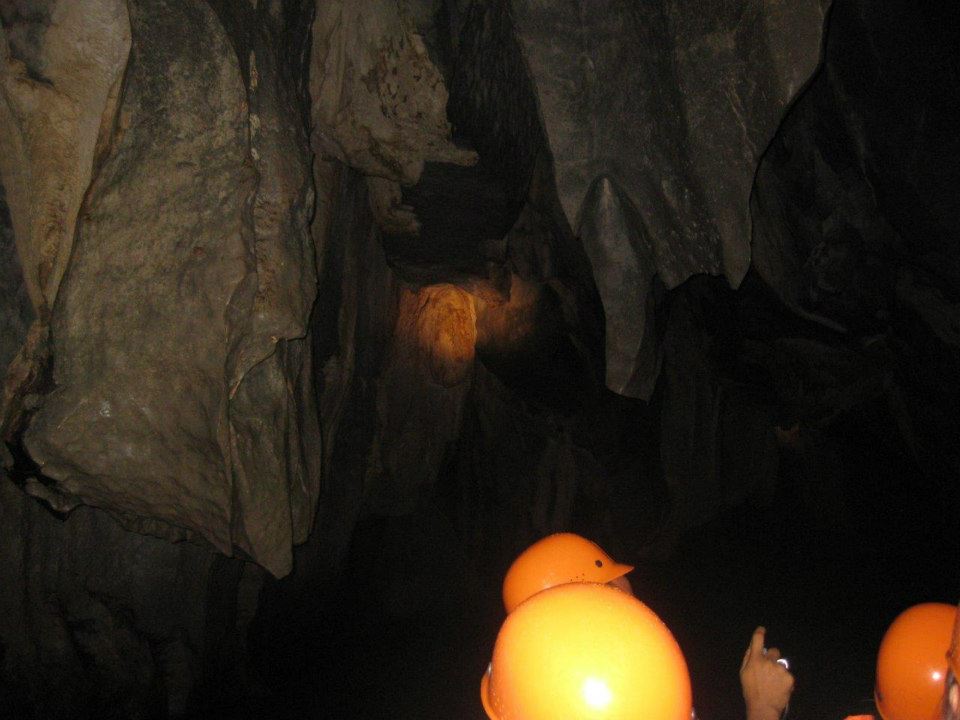
Water continuously fell from the roof of the cave but all passengers are provided with hard hats and life vests. Our Boat Captain, who calls himself “Joy to the World,” is also our humorous tourist guide. As we entered, we saw stalactites hanging downwards from the roof of the cave.  These lime rock formations grow at  0.2 meters per year.

It was dark inside but we had a male volunteer holding the flashlight focusing on the creative formations.  Inside the enchanting cave, there is what they call The Cathedral, which has a big candle-like stalagmite that stands at the entrance.  There were rocks forming many images like The Holy Family, angels, saints, and church-like structures. They have rock formations that looks like corn, vegetables,   garlic, onions, bread and many more, which they call Supermarket.  There were also formations like a music bar, a sexy woman and more to the imagination.


We noticed there are writings on the wall by American soldiers.  They were the brave soldiers who explored the cave when natives believed there were evil spirits inside. It was only in 1971 when the authorities decided to appreciate its great wonder.

There are also 100,000 bats and swallows that inhabit the underground river. They peacefully co-exist since swallows wake and make their Nido bird’s nests during the day while bats work at night.


Our next destination was the Ugong Rock, where a cave of stalactites and stalagmites can be touched. At the end of this cave is a zip line.  They call it spelunking.  Our tour companions, Liza and her family (from LA) and Faif (from Singapore) did the spelunking while we cheered.

That night, we had a sumptuous dinner at a seafood restaurant called Ugong Rock with Dr. Grace.  Her husband, Ed, just joined us for picture-taking. 


The next day, we went shopping for pearl necklaces and bracelets, toys, kasuy (cashew), and many delicacies!  Palawan is noted for pearls such as expensive South Sea Pearls, Fresh Water pearls and cultured Mikimoto pearls.


On our final day, we went to the Mitra Farm, where there are horses, cows, zip line and an organic vegetable farm.  We also visited Baker’s Hill, which sells crinkles, kasuy, hopia, and delicacies.  There were stores selling pizza, banana cue, fruit juices and a restaurant where we had halo-halo (boiled banana, milk, crushed ice and custard and more) as well. The place has many flower decorations and a  refreshing garden, where visitors take turns to pose for pictures.


We were, indeed, blessed with good weather.  Special thanks to the prayers of the Sisters of the Augustinian Recollect and Scuola Figlie di Maria Immacolata of Paranaque, and churchmates. Even our flight with Philippine Air Lines was wonderful with its famous soft landing!

Finally, I was able to capture a part of the world-renown, Palawan - may this wonder-of-a-place together with its responsible and environment-friendly people, be our inspiration.

*Photos courtesy of Lily Jane Makanas-Pacheco

alternative medicine

Green Tea: The Cancer Solution

8:04 PM

Image from: http://overtheteacups.com/teabriefs/green-tea-for-weight-loss/


Green Tea comes from:

1.       China plant, an evergreen small-leaved bush, scientifically called Camellia Sinensis  and;

2.       Assam plant, a large-leaved tree, scientifically called Sinensis AssamIca.  (Read Tea Break Time for more information.)

In his book “The Cancer Solution”, Dr. Robert Wilner (USA) describes green tea as the delicate pale tea. It is said to be a source of an anti-carcinogenic substance called EGCG or Epigallocatechin Gallate. This substance inhibits the growth of cancer cells, lowers cholesterol levels, and promotes good health and longevity.

In Japan, green tea is considered a tea-food. For while drinking the beverage, the Japanese also eat the leaves. This way they are able to get the optimum value of the herbal medicine instead of throwing this precious food away as waste.  Professor Kazutami Kuwano of the Kesei Gakumi Junior College investigated on its vitamin content. According to him, one (1) tsp. (or 2 g.) of dried green tea to a cup of hot water, contains 50% of Vitamin E and 20% of Vitamin A. For best results, he recommends 3 cups of tea a day.


Get your Green Tea plant at  https://herbalandherbs.wordpress.com/ for Php150-180/seedling. 

*No calories in green tea leaves.

Now that we know the importance of Green Tea, here are important tips for best results. (Tips also good for all medicinal tea):

1.       Tea should be taken in frequent small sips through the day rather than all at once. As a general rule, one half to one cup (8 ounces) of tea 3 to 4 times/day during a 16-hour period is suggested.  This will allow absorption of the liquid into the body.   

2.       Tea removes toxins from the body system.  But the tea also brings with it the body’s water reserves manifested by excessive urination. Over-drinking tea can cause dehydration and some illnesses.  (Read more on Do You Drink Water Sip bySip?)

3.       Too much processing create losses of volatile oils. Instead, just crumble the dried leaves, flowers, bark, roots before steeping for best results then steep in hot water for 15 minutes.

I have Assam tree in my garden.  It needs moisture daily and sunlight as well.  Assam plant has big leaves and the best tea comes from the bud and the two youngest leaves.  But the other matured leaves can also be used.  Green tea from both youngest and matured leaves turn yellow green – amazing!


The roots of Western herbal medicine was influenced by ancient Greeks especially, Hippocrates during the period 460 to 377 BC.  But chronologically speaking, Green Tea is be the oldest herbal with the discovery of Camellia Sinensis as early as 2700BC at Tibet, China. (Tea History – Read more on Tea Break Time.)


Get your Green Tea plant at  https://herbalandherbs.wordpress.com/ for Php100-150/seedling. 


Indeed, Green Tea has a long history and continues to make history until the present time.  

EM-EM
THE GARDENER, MBA

Sources:

Hobert, Ingrid &  Tietze, Harald, Final Remark from Harald, Guava for Modern Diseases, p.83, New Delhi, India, B.Jain Publishers(P)Ltd.

Harding, Jennie, Ancient Herbal History, Holistic Herb p. 10, UK, Parragon Publishing Book  2002, 
Encyclopedia Brittanica 15th edition, Beverage Production, Macropedia 14, p. 755, USA.

Rector-Page, Linda, Herbal preparation method, Healthy Healing, p. 13Healthy Healing Publications, USA

kinds of tea

GREEN TEA BREAK TIME: BLACK, OOLONG OR GREEN TEA

8:15 PM

Believe it or not, black, oolong and green teas come from the same tea plant! It is just the processing that makes the distinction between these three.

Tea plant only comes from two (2) principal varieties and they are:

1   1. China plant – This variety is the most ancient, which was originally discovered in Tibet, China. This is an evergreen bush scientifically known as Camellia Sinensis.
2   2.  Assam plant – This was consequently discovered in Assam, India.  This is a tree that is scientifically known as Sinensis Assamusca.

Get your Green Tea https://herbalandherbs.wordpress.com/ for Php100-150/seedling.  

From these two variants, Camellia Sinensis and Assam Sinensis, tea bred to more or less 1,600 varieties.  And to be able to process a flavorful and stimulating tea, expert tasters blended 20 or more varieties to produce the best quality for people with discriminating taste. Among these varieties are:

1    1.  Black tea – A fermented tea which drinkers love because of its fast stimulation.  An example of which are the English Breakfast Tea and Russian Tea.  Many fermented teas are blended with other teas like Earl Grey which is produced by adding Bergamot flavor.
2   2.  Oolong Tea – Semi-fermented tea which produce a light brownish green tea. This tea is slightly bitter and stimulating.
3   3. Green Tea – This tea is not fermented and produces greenish yellow tea when boiled.  Its taste is slightly bitter. This is not a stimulating beverage but has a steadier and lasting effect.

Western people prefer tea to coffee.  But there should also be caution in how much tea one intakes, especially for people with high blood pressure. Tea gives fast stimulating effect because of alkaloid caffeine. 

Alkaloid caffeine contains caffeine that range from 1 to 5% of the tea itself. Caffeine stimulates the nervous system, heart, lungs, and promote urine production.

Alkaloid caffeine content is also present in coffee, colas, mate tea (Paraguariensis), and cacao in chocolate. Chocolate has minimal content though. One ounce (28.3grams) of chocolate contains only 10-20mg of alkaloid caffeine.

Tea as a beverage prides itself of a long history, useful discoveries and commerce that we are benefitting now. Check out the timeline below!

2700 BC
Discovery of china plant in Tibet, China.
800 AD
Introduced in Japan for Zen Buddhists to keep them awake during meditation. Developed into social drinking and Tea Ceremony practiced until the present.
1559 AD
Tea was mentioned as Cha Catai in Gian Battista Ramusio’s literature, Voyages and Travel.
1610
The Dutch brought China plant and eventually, Assam plant to Europe.
1669
The English brought tea to England.
1840
Duchess of Bedford introduced tea drinking in Britain and British Empire. Since then, tea became the Englishman’s most popular beverage.
1904
Discovery of iced tea during the St. Louis World Fair in Minnesota.  It was so hot that no one was interested with hot tea.  Englishman Richard Blechynden in his desire to attract customers placed ice on a glass of tea and the rest is history.
1940
The discovery of teabags and instant drink:  Thomas Sullivan decided to sew tea sample tea in cloth as a substitute for the costly tin can.  This was the start of using teabags.

I am lucky to have a tea tree, which, in my research, belong to the Assam plant variety. Here's an up-close picture of its leaf. 


After boiling for 15 minutes, the tea was, indeed, green and yellow and slightly bitter. The part of the plant used for tea are the buds and the first two young leaves for best results, although the other leaves can also be used. 


Get your Green Tea https://herbalandherbs.wordpress.com/ for Php150-180/seedling.  

Tea drinking has been passed on for generations and its long history shows how challenges of their time brought breakthroughs that we are now enjoying!

With that said, have a great tea break time!


EM-EM
The Herbal & Herbs Gardener, MBA

Sources:

Compto’s Encylopedia 23, Tea p. 44, Encyclopedia Brittanica 1991 Edition
Micropedia 2, Tea p. 764, Encyclopedia Brittanica, 1992                                                                  
 Micropedia 11, Tea p. 596, Encyclopedia Britannica, 1992
Micropedia  13,  Theales  p.  6s45, Encylopedia Britannica, 1992
Micropedia 14, Tea p.  75 5, Encyclopedia Brittanica, 1992
Cal Orey, Chocolate Compounds (Caffeine), The Healing Powers of Chocolate, 2010,  p. 38, New York, Kensington Publishing Corp.

Ingfried Hobert & Harald Tietze, Final Remark from Harald, Guava Medicine for Modern Diseases, 2009,  pp. 82- 83, New Delhi, India, B. Jain Publishers(P) Ltd.

Dokudami

Dokumdami: For Detox, Body Aging, Nose Congestion, Histamine Blocker, Free Radical Scavenger & More!

8:50 PM


Dokudami


Dokudami is known world wide. In China, it is called Houttuynia Cordata, taken from the name of the Dutch scientist, Dr. Houttuynia and Cordata, the Latin word for heart, because of the shape of its leaf. It is also known even as far as US and Australia as heartleaf and lizard tail. It is also called fish mint or fish wort because of its fishy smell. But in Japan where it originated, Dokudami literally means poison block because of its ancient cure-all properties. It gets rid of toxins to control asthma and allergies, body aging, cancer, acne, and more.

Get your Dokudami at https://herbalandherbs.wordpress.com/ at Php60/seedling bag.

This herbal is both traditional medicine and food that can be taken fresh or dried as tea or as vegetable. This perennial plant grows well with the least sunlight or in total shade with sufficient moisture.  

As medicine, it can be taken orally or externally.  In Japan, it is made into tea called Dokudami Cha. Taken orally, it controls pneumonia, pleurisy, cough, chronic urinary or cervical infection, fever, gastritis, dyspepsia, tumors and more.  Applied externally, it has shown effectiveness in swelling, hemorrhoids, and can be used as urinary antiseptic and for congested nose (rub on nostrils) and many more.  This herbal is used for detox footpads to remove body waste and also used for herbal bath.   
     
There are 6 verified benefits of Dokudami:

1. Histamine Blocker – It controls overproduction of histamine that causes asthma, allergies and anaphylactic shock.
2. Free Radical Scavenger – It prevents body aging and diseases like cancer. It has Polypenol, an active free radical-neutralizing chemical that fights free radicals that is caused by burned food, processed food, pollution.
3. Controls Bacteria – It evidently controls acne-producing bacteria like Staphylococcus Epidermis and Propionibacterin.
4. Increase immune system – It stimulates lympocytes, a part of the body’s defense mechanism.
5. Reduce inflammation – It is one of the eight compounds in Chinese medicine that was used to cure SARS (Severe Acute Respiratory Syndrome).
6. Anti-microbial, Disinfectant, and Anti-inflammatory 

As food, it is used as garnish in Vietnam.  In North Eastern India, it is called Ja Mardoh and is used as salad or cooked vegetable.

Get your Dokudami at https://herbalandherbs.wordpress.com/ at Php60/seedling bag.

I had colds and slight asthma this May. To test the benefits of Dokudami, I ate 3 fresh leaves with vinegar and garlic several times. I even tried to put it in fish sauce. In a short time, I was back to normal. I also added some leaves in both our noodle soup and vegetable soup and even tried adding it to our breakfast fried rice with dilis (anchovy).    

With my allergic tendencies to antibiotics, I am thankful that we have Dokudami available. It serves as a histamine blocker which controls anaphylactic shock.  According to Encyclopedia Brittanica, anaphylactic shock is an antigen-antibody reaction of the body from antibiotics causing skin flushing and itchiness of the whole body, etc. I have had several not-so-good experiences of anaphylactic shock and this is why I am extra careful when taking antibiotics. Dokudami is definitely heaven’s gift for me.

Em-em
The Gardener


Sources:

Benefits of Dokudami. Retrieved from http://www.globalhealingcenter.com/benefits-of/dokudami.

Houttuynia Cordata. Retrieved from http://en.wikipedia.org/wiki/Houttuynia_cordata.

Anaphylaxis. In Encyclopedia Brittanica. (pp. 370-371).