Palawan

CAPTURING A PART OF PALAWAN – Puerto Princesa and the Underground River!

2:08 AM


In mid-July, my high school classmates (PWU, Taft Ave., Manila) invited me to go to Palawan.   I immediately said yes because it is my dream to see this clean and green place.  Our classmate, Dra. Grace, an OB Gyne, who is based there arranged for our hotel and tour.

I travel light.  I travel green with my herbal and herbs.  I brought with me small quantities of my  homemade toiletries such as Gugo Shampoo, Aloe Vera Rinse, Aloe  Sanitizer, Citronella-Mint oil/Mosquito Repellant,  and Citronella-Mint Deodorant.  (Check out How to Make Gugo Shampoo, The Versatile Citronella, Aloe Vera: The Added Value, and Herbal and Herbs in Personal Care: Aloe Vera, Mints & Citronella).  

For food, I prepared a sandwich made of homemade tuna belly with mushroom and carrots in olive oil mixed with Basil, Oregano, Kuchai Leek, and Ashitaba. I also brought fresh Ashitaba leaves since it is good for the immune system, respiratory and digestive systems. And for drink, I brought some dried Tarrragon leaves. I placed these leaves in my water container for calmness and sweet taste.  (Check out Ashitaba & The Other Angelica Herbals All Over The World and Herbal Tea & Juice).

In August 8, 2013,   my classmates Lily Jane (from California), Regie, Rose and I took the plane to Palawan.   Our hostess welcomed us with gifts!


As soon as we reached the hotel, Lily Jane and I decided to contract a tricycle to bring us to the churches.  Boyet, the driver, was like a tourist guide showing to us important spots.  He was also our cameraman, and seemed amused to see two matured women acting like high school girls.  


First, we went to Immaculate Concepcion Cathedral. Right beside it is the American POW Memorial and Garden.  The Americans were imprisoned there and burned to death during the Japanese occupation.  


We also went to the Iglesia ni Kristo Church, and finally, to the San Miguel Arkangel Church located behind our hotel. 

In our short trip, I did not see anyone smoking nor did I see any wrapper, paper, plastic  nor cigarette butts on the streets.

For dinner, we went to a well-known restaurant serving authentic Vietnamese cuisine.  The place is just a simple hut.  They served us their version of lumpia (eggroll with vegetables) and another type filled with vegetable and shrimps.  They also served us their own dried rice noodles (I thought these were coconut shreds) with togue (mungbean sprouts), cucumber, Java Mint and Beef.  It did not have soup no sauce, just vinegar with garlic to add more flavor. (Side note: When I got home, I also tried my own version.  Instead of Vietnamese rice noodles, which is not available in my kitchen, I used sotanghon.  My family liked the authentic taste with Java Mint included.  A discovery!)


The next day, we went to one of The Seven Wonders of the World known as the Underground River.  It is located at Cabayungay, Sabang, which is more or less two hours away from the city.   Along the way, the mountains were verdant with tall trees showing how cooperative the Palawenos are with nature.  I can only hope other provinces would do same.


The sand in Sabang pier is fine and colored cream and it felt so good to go barefoot. We rode a motor boat over the South China Sea.  The smooth rhythm of the sea waves together with the gentle wind was like a natural massage.


At the Underground River Park, there is a monkey that enjoyed posing for pictures.  But we were warned not to bring out  any food.  Any smell of food or sound of plastic might attract a troop 20 to 40 monkeys


We walked through a wooden path surrounded with big trees.  Some of these are:

1.       Ipil Tree (Fabacea Intsia Biyuga) -  This has bigger leaves compared to the Ipil-Ipil.
2.       Pahutan (Mereangifera Altissima Blanco) - This is the food of the monkeys.  The fruit of this tree is a mango variant, which is edible but not popular to residents because of its medicine-like taste.
3.       Bitanog/Dangkalam (Catophyllum Inophyllum Guttiferaea) – A huge tree as seen below.


We also saw a small crocodile-like animal.  Actually, it is a Monitor Lizard or Bayawak (Varonus Salvator) which is common at the park.  These are endangered species scavenging for mammals, birds, eggs, fruits, etc.  The largest size Is 2 meters.


It drizzled as we entered the cave of the Underground River.


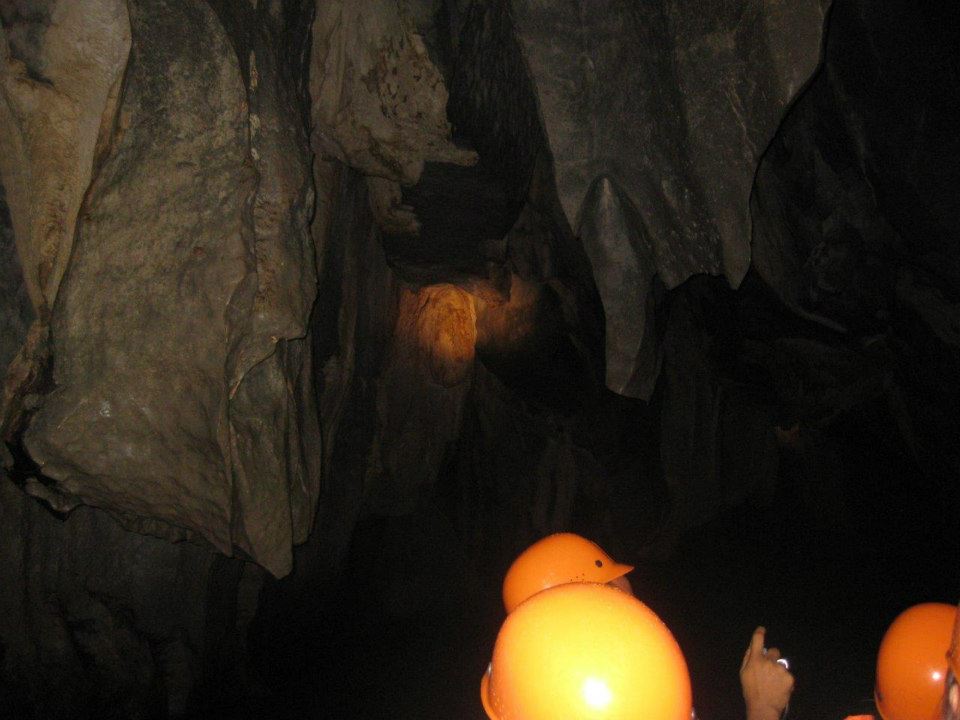
Water continuously fell from the roof of the cave but all passengers are provided with hard hats and life vests. Our Boat Captain, who calls himself “Joy to the World,” is also our humorous tourist guide. As we entered, we saw stalactites hanging downwards from the roof of the cave.  These lime rock formations grow at  0.2 meters per year.

It was dark inside but we had a male volunteer holding the flashlight focusing on the creative formations.  Inside the enchanting cave, there is what they call The Cathedral, which has a big candle-like stalagmite that stands at the entrance.  There were rocks forming many images like The Holy Family, angels, saints, and church-like structures. They have rock formations that looks like corn, vegetables,   garlic, onions, bread and many more, which they call Supermarket.  There were also formations like a music bar, a sexy woman and more to the imagination.


We noticed there are writings on the wall by American soldiers.  They were the brave soldiers who explored the cave when natives believed there were evil spirits inside. It was only in 1971 when the authorities decided to appreciate its great wonder.

There are also 100,000 bats and swallows that inhabit the underground river. They peacefully co-exist since swallows wake and make their Nido bird’s nests during the day while bats work at night.


Our next destination was the Ugong Rock, where a cave of stalactites and stalagmites can be touched. At the end of this cave is a zip line.  They call it spelunking.  Our tour companions, Liza and her family (from LA) and Faif (from Singapore) did the spelunking while we cheered.

That night, we had a sumptuous dinner at a seafood restaurant called Ugong Rock with Dr. Grace.  Her husband, Ed, just joined us for picture-taking. 


The next day, we went shopping for pearl necklaces and bracelets, toys, kasuy (cashew), and many delicacies!  Palawan is noted for pearls such as expensive South Sea Pearls, Fresh Water pearls and cultured Mikimoto pearls.


On our final day, we went to the Mitra Farm, where there are horses, cows, zip line and an organic vegetable farm.  We also visited Baker’s Hill, which sells crinkles, kasuy, hopia, and delicacies.  There were stores selling pizza, banana cue, fruit juices and a restaurant where we had halo-halo (boiled banana, milk, crushed ice and custard and more) as well. The place has many flower decorations and a  refreshing garden, where visitors take turns to pose for pictures.


We were, indeed, blessed with good weather.  Special thanks to the prayers of the Sisters of the Augustinian Recollect and Scuola Figlie di Maria Immacolata of Paranaque, and churchmates. Even our flight with Philippine Air Lines was wonderful with its famous soft landing!

Finally, I was able to capture a part of the world-renown, Palawan - may this wonder-of-a-place together with its responsible and environment-friendly people, be our inspiration.

*Photos courtesy of Lily Jane Makanas-Pacheco

alternative medicine

Green Tea: The Cancer Solution

8:04 PM

Image from: http://overtheteacups.com/teabriefs/green-tea-for-weight-loss/


Green Tea comes from:

1.       China plant, an evergreen small-leaved bush, scientifically called Camellia Sinensis  and;

2.       Assam plant, a large-leaved tree, scientifically called Sinensis AssamIca.  (Read Tea Break Time for more information.)

In his book “The Cancer Solution”, Dr. Robert Wilner (USA) describes green tea as the delicate pale tea. It is said to be a source of an anti-carcinogenic substance called EGCG or Epigallocatechin Gallate. This substance inhibits the growth of cancer cells, lowers cholesterol levels, and promotes good health and longevity.

In Japan, green tea is considered a tea-food. For while drinking the beverage, the Japanese also eat the leaves. This way they are able to get the optimum value of the herbal medicine instead of throwing this precious food away as waste.  Professor Kazutami Kuwano of the Kesei Gakumi Junior College investigated on its vitamin content. According to him, one (1) tsp. (or 2 g.) of dried green tea to a cup of hot water, contains 50% of Vitamin E and 20% of Vitamin A. For best results, he recommends 3 cups of tea a day.


Get your Green Tea plant at  https://herbalandherbs.wordpress.com/ for Php150-180/seedling. 

*No calories in green tea leaves.

Now that we know the importance of Green Tea, here are important tips for best results. (Tips also good for all medicinal tea):

1.       Tea should be taken in frequent small sips through the day rather than all at once. As a general rule, one half to one cup (8 ounces) of tea 3 to 4 times/day during a 16-hour period is suggested.  This will allow absorption of the liquid into the body.   

2.       Tea removes toxins from the body system.  But the tea also brings with it the body’s water reserves manifested by excessive urination. Over-drinking tea can cause dehydration and some illnesses.  (Read more on Do You Drink Water Sip bySip?)

3.       Too much processing create losses of volatile oils. Instead, just crumble the dried leaves, flowers, bark, roots before steeping for best results then steep in hot water for 15 minutes.

I have Assam tree in my garden.  It needs moisture daily and sunlight as well.  Assam plant has big leaves and the best tea comes from the bud and the two youngest leaves.  But the other matured leaves can also be used.  Green tea from both youngest and matured leaves turn yellow green – amazing!


The roots of Western herbal medicine was influenced by ancient Greeks especially, Hippocrates during the period 460 to 377 BC.  But chronologically speaking, Green Tea is be the oldest herbal with the discovery of Camellia Sinensis as early as 2700BC at Tibet, China. (Tea History – Read more on Tea Break Time.)


Get your Green Tea plant at  https://herbalandherbs.wordpress.com/ for Php100-150/seedling. 


Indeed, Green Tea has a long history and continues to make history until the present time.  

EM-EM
THE GARDENER, MBA

Sources:

Hobert, Ingrid &  Tietze, Harald, Final Remark from Harald, Guava for Modern Diseases, p.83, New Delhi, India, B.Jain Publishers(P)Ltd.

Harding, Jennie, Ancient Herbal History, Holistic Herb p. 10, UK, Parragon Publishing Book  2002, 
Encyclopedia Brittanica 15th edition, Beverage Production, Macropedia 14, p. 755, USA.

Rector-Page, Linda, Herbal preparation method, Healthy Healing, p. 13Healthy Healing Publications, USA

kinds of tea

GREEN TEA BREAK TIME: BLACK, OOLONG OR GREEN TEA

8:15 PM

Believe it or not, black, oolong and green teas come from the same tea plant! It is just the processing that makes the distinction between these three.

Tea plant only comes from two (2) principal varieties and they are:

1   1. China plant – This variety is the most ancient, which was originally discovered in Tibet, China. This is an evergreen bush scientifically known as Camellia Sinensis.
2   2.  Assam plant – This was consequently discovered in Assam, India.  This is a tree that is scientifically known as Sinensis Assamusca.

Get your Green Tea https://herbalandherbs.wordpress.com/ for Php100-150/seedling.  

From these two variants, Camellia Sinensis and Assam Sinensis, tea bred to more or less 1,600 varieties.  And to be able to process a flavorful and stimulating tea, expert tasters blended 20 or more varieties to produce the best quality for people with discriminating taste. Among these varieties are:

1    1.  Black tea – A fermented tea which drinkers love because of its fast stimulation.  An example of which are the English Breakfast Tea and Russian Tea.  Many fermented teas are blended with other teas like Earl Grey which is produced by adding Bergamot flavor.
2   2.  Oolong Tea – Semi-fermented tea which produce a light brownish green tea. This tea is slightly bitter and stimulating.
3   3. Green Tea – This tea is not fermented and produces greenish yellow tea when boiled.  Its taste is slightly bitter. This is not a stimulating beverage but has a steadier and lasting effect.

Western people prefer tea to coffee.  But there should also be caution in how much tea one intakes, especially for people with high blood pressure. Tea gives fast stimulating effect because of alkaloid caffeine. 

Alkaloid caffeine contains caffeine that range from 1 to 5% of the tea itself. Caffeine stimulates the nervous system, heart, lungs, and promote urine production.

Alkaloid caffeine content is also present in coffee, colas, mate tea (Paraguariensis), and cacao in chocolate. Chocolate has minimal content though. One ounce (28.3grams) of chocolate contains only 10-20mg of alkaloid caffeine.

Tea as a beverage prides itself of a long history, useful discoveries and commerce that we are benefitting now. Check out the timeline below!

2700 BC
Discovery of china plant in Tibet, China.
800 AD
Introduced in Japan for Zen Buddhists to keep them awake during meditation. Developed into social drinking and Tea Ceremony practiced until the present.
1559 AD
Tea was mentioned as Cha Catai in Gian Battista Ramusio’s literature, Voyages and Travel.
1610
The Dutch brought China plant and eventually, Assam plant to Europe.
1669
The English brought tea to England.
1840
Duchess of Bedford introduced tea drinking in Britain and British Empire. Since then, tea became the Englishman’s most popular beverage.
1904
Discovery of iced tea during the St. Louis World Fair in Minnesota.  It was so hot that no one was interested with hot tea.  Englishman Richard Blechynden in his desire to attract customers placed ice on a glass of tea and the rest is history.
1940
The discovery of teabags and instant drink:  Thomas Sullivan decided to sew tea sample tea in cloth as a substitute for the costly tin can.  This was the start of using teabags.

I am lucky to have a tea tree, which, in my research, belong to the Assam plant variety. Here's an up-close picture of its leaf. 


After boiling for 15 minutes, the tea was, indeed, green and yellow and slightly bitter. The part of the plant used for tea are the buds and the first two young leaves for best results, although the other leaves can also be used. 


Get your Green Tea https://herbalandherbs.wordpress.com/ for Php150-180/seedling.  

Tea drinking has been passed on for generations and its long history shows how challenges of their time brought breakthroughs that we are now enjoying!

With that said, have a great tea break time!


EM-EM
The Herbal & Herbs Gardener, MBA

Sources:

Compto’s Encylopedia 23, Tea p. 44, Encyclopedia Brittanica 1991 Edition
Micropedia 2, Tea p. 764, Encyclopedia Brittanica, 1992                                                                  
 Micropedia 11, Tea p. 596, Encyclopedia Britannica, 1992
Micropedia  13,  Theales  p.  6s45, Encylopedia Britannica, 1992
Micropedia 14, Tea p.  75 5, Encyclopedia Brittanica, 1992
Cal Orey, Chocolate Compounds (Caffeine), The Healing Powers of Chocolate, 2010,  p. 38, New York, Kensington Publishing Corp.

Ingfried Hobert & Harald Tietze, Final Remark from Harald, Guava Medicine for Modern Diseases, 2009,  pp. 82- 83, New Delhi, India, B. Jain Publishers(P) Ltd.

Dokudami

Dokumdami: For Detox, Body Aging, Nose Congestion, Histamine Blocker, Free Radical Scavenger & More!

8:50 PM


Dokudami


Dokudami is known world wide. In China, it is called Houttuynia Cordata, taken from the name of the Dutch scientist, Dr. Houttuynia and Cordata, the Latin word for heart, because of the shape of its leaf. It is also known even as far as US and Australia as heartleaf and lizard tail. It is also called fish mint or fish wort because of its fishy smell. But in Japan where it originated, Dokudami literally means poison block because of its ancient cure-all properties. It gets rid of toxins to control asthma and allergies, body aging, cancer, acne, and more.

Get your Dokudami at https://herbalandherbs.wordpress.com/ at Php60/seedling bag.

This herbal is both traditional medicine and food that can be taken fresh or dried as tea or as vegetable. This perennial plant grows well with the least sunlight or in total shade with sufficient moisture.  

As medicine, it can be taken orally or externally.  In Japan, it is made into tea called Dokudami Cha. Taken orally, it controls pneumonia, pleurisy, cough, chronic urinary or cervical infection, fever, gastritis, dyspepsia, tumors and more.  Applied externally, it has shown effectiveness in swelling, hemorrhoids, and can be used as urinary antiseptic and for congested nose (rub on nostrils) and many more.  This herbal is used for detox footpads to remove body waste and also used for herbal bath.   
     
There are 6 verified benefits of Dokudami:

1. Histamine Blocker – It controls overproduction of histamine that causes asthma, allergies and anaphylactic shock.
2. Free Radical Scavenger – It prevents body aging and diseases like cancer. It has Polypenol, an active free radical-neutralizing chemical that fights free radicals that is caused by burned food, processed food, pollution.
3. Controls Bacteria – It evidently controls acne-producing bacteria like Staphylococcus Epidermis and Propionibacterin.
4. Increase immune system – It stimulates lympocytes, a part of the body’s defense mechanism.
5. Reduce inflammation – It is one of the eight compounds in Chinese medicine that was used to cure SARS (Severe Acute Respiratory Syndrome).
6. Anti-microbial, Disinfectant, and Anti-inflammatory 

As food, it is used as garnish in Vietnam.  In North Eastern India, it is called Ja Mardoh and is used as salad or cooked vegetable.

Get your Dokudami at https://herbalandherbs.wordpress.com/ at Php60/seedling bag.

I had colds and slight asthma this May. To test the benefits of Dokudami, I ate 3 fresh leaves with vinegar and garlic several times. I even tried to put it in fish sauce. In a short time, I was back to normal. I also added some leaves in both our noodle soup and vegetable soup and even tried adding it to our breakfast fried rice with dilis (anchovy).    

With my allergic tendencies to antibiotics, I am thankful that we have Dokudami available. It serves as a histamine blocker which controls anaphylactic shock.  According to Encyclopedia Brittanica, anaphylactic shock is an antigen-antibody reaction of the body from antibiotics causing skin flushing and itchiness of the whole body, etc. I have had several not-so-good experiences of anaphylactic shock and this is why I am extra careful when taking antibiotics. Dokudami is definitely heaven’s gift for me.

Em-em
The Gardener


Sources:

Benefits of Dokudami. Retrieved from http://www.globalhealingcenter.com/benefits-of/dokudami.

Houttuynia Cordata. Retrieved from http://en.wikipedia.org/wiki/Houttuynia_cordata.

Anaphylaxis. In Encyclopedia Brittanica. (pp. 370-371). 

dehydration

Dehydrated: Do You Drink Water Sip By Sip?

2:29 AM


Water is the best drink. It's best taken when it's naturally cold or warm. Naturally cold water promotes secretion of toxins through the skin and increases excretion of poison through the urine. Warm water, meanwhile, stimulates the inner lining of the stomach, contracts blood vessels, and lessens the secretion of acids from the glands. The best way to drink water is to take it sip by sip, making sure that saliva is mixed with it before swallowing.
Dehydration

Dehydration is the excessive loss of water. Dehydration causes imbalance of sodium, potassium and chloride, which are the minerals that help distribute water to  the vital organs. Thirst, loss of skin elasticity, dry skin, decreased urine, irritability, confusion caused by excessive sweating, fever, diarrhea, and vomiting are just some of the signs of dehydration. It is important to note also that some conditions do not manifest dehydration just by thirst. For some, the body expresses thirst through stomach pains after eating, chest pain, joint pain, headache and even backaches.

Dehydration can also cause stress. Stress, in turn, causes further dehydration. Depression, the exaggerated feeling of sadness, worthlessness and rejection can also cause dehydration. It is important to note that staying hydrated is very important for the brain because water generates electrical energy. The body tends to secrete higher amounts of the following hormones during dehydration:

  1. Endorphins – These are produced by the pituitary glands.  These hormones reduce pain but too much of it may affect normal pain reaction.
  2. Cortisone – This is a chemical compound produced by the liver.  Prolonged action of this depletes body water reserves.
  3. Prolactin - This hormone is produced by the pituitary glands for milk production. Increased secretion due to chronic dehydration can cause breast tumour.
  4. Vasopressin- This is secreted by the pituitary glands.  This is one of the hormones that distribute water to vital organs.  When you are dehydrated, more cells dutifully produce vasopressin to be able to regulate water.
Drinks like alcohol, coffee, tea and carbonate drinks suppress secretion of these hormones. Thus, these fluids can cause dehydration in some organs of the body.

Some illnesses may be controlled if water is drank properly. Adequate water can delay the onset or severity of hypertension just by drinking enough water. For asthmatics, more histamine in the lungs can cause constriction of the air passages and coughing due to thick mucus secretions. This constriction can cause dehydration. Simply drinking 10 glasses of water or more reduces histamine production just in a few weeks because of adequate supply of water in all body cells.

Imagine, just by simply drinking slowly, there can be so much relief from many of our ailments!  But when I read that water should be sipped little by little, I had to unlearn my drinking habits.  It is still a continuous challenge.

When Not to Drink Water

Dr. Ramaiah recommends not to drink water while eating. This can affect food digestion and secretion of saliva. Water leaves the stomach in 5 to 10 minutes of drinking it and brings some of the food with it. Too much water can cause indigestion. It is recommended to drink water with empty stomach 1 ½ hours before meals and 3 hours after meals. He also recommends not to drink water or any liquid with straw. 

China Daily (www.chinadaily.com.cn) discussed the 'Water Drinking Table'. It suggests drinking water 30 minutes before breakfast 8 oz. or 250 cc. of water to clean the liver and kidneys. Then, practically every two hours to moisturize the body, keep focus and decrease work-related stress. Drinking water 30 minutes to one hour before sleeping is also recommended to prevent blood clots.
   
There is no substitute for water. We should drink more water often to hydrate our bodies so it can function more effectively. Happy water drinking!  Cheers for health and beauty!


EM-EM

Herbal Gardener, MBA                                                                                                         


Source:

Healing Powers of Water, Dr. Savitri Ramaiah © 2009, Sterling Publishers Pvt.Ltd., New Delhi
How to Drink Water. Lifestyle.com, China Daily.com.cn, City Life

Cancer

Guyabano, The Natural Chemotheraphy: For Liver, Arthritis & More!

7:56 PM


About twenty years ago, in one of our visits to my mother-in-law, Serafina, at Tigbauan, Iloilo (Island of Visayas), I overheard her cough overnight.  The next day, I asked her for a herbal that can relieve her cough.  She gave me leaves she called Babana.  Every night, I boiled some leaves into tea which she drunk before sleeping.  She slept soundly while we were there.

Babana in Ilonggo comes from the Spanish word Guabana.  It is also commonly called Guyabano in the Philippines.  Its scientific name is Anona Muricata and internationally known as Graviola Tree.

The fruit of the Guyabano is very rich in Vitamin C.  Aside from lots of fiber, it is also rich in Vitamins B1, B2 and K.  The fruit and juice are good for the liver and even works against worms.  While the crushed fresh leaves can be boiled and used as compress for swollen feet and inflammations or can be made into poultice for rheumatism.

For other medicinal plants for sale, visit https://herbalandherbs.wordpress.com/.

In the internet article, Natural Cancer Cell Killer, it is said to increase immune system to protect the body from heart and liver disease, asthma, arthritis and cancer of the colon, breast, prostate and pancreas.  For healing, they also recommend the 30- DAY PROTOCOL or drinking the tea three times a day for 30 days.
  
Many have shared with me the good effects manifested by the healing power of Guyabano but it should be taken the right way to prevent adverse reactions.  For it is common for Filipinos to drink herbal tea as agua tiempo or as a substitute for water.

But Dr. Ramiah of Healing Powers of Water says that “Tea, coffee, aerated drinks and alcohol contain substances that dehydrate”.  As the saying goes “Too much of everything is bad.”  Thus, Guyabano Tea should be taken as follows:

5 leaves per glass of 8 oz.
3 x a day for 30 days                                                                                  
30 minutes before meals or 1 ½ hours after meals
REST for 10 days -   reduce little by little before stopping

For other medicinal plants for sale, visit https://herbalandherbs.wordpress.com/.

Remember:

  1. Sip tea little by little for best effect;
  2. Avoid the use of straw for tea or any kind of fluid;
  3. There is no substitute for water.

Em-Em
Herbal Gardener, MBA

Sources:

Benefits

Tablea, Chocolate Bars & Healing!

10:36 PM


When I have back pains, colds, coughs or wheezing, I crave for hot chocolate.  I make hot chocolate by boiling one tablet of Tablea (more or less 100% Cacao) and drink it hot without milk nor any sugar added.  I usually add either Tarragon, Mint or Peppermint and after a few sips I definitely feel r-e-l-a-x-e-d!

We are lucky in the Philippines because we produce Cacao.  These beans are processed in the form of Tablea either using the traditional way with a manual grinder or its modern machine counterpart. Out of Cacao, chocolate bars, truffles and cocoa powder for chocolate drinks and baked products can be produced.  Processed milk chocolate bars may contain 49% cocoa while dark chocolate contains about 70% cocoa.


Get your Pure Batangas Tablea at https://herbalandherbs.wordpress.com/ at Php40/50 gram pack.

The closer to the bean, the healthier chocolate is for you. But drinking it pure and dark with its bitter taste may only be acceptable to the health conscious.  It may be made more enjoyable and healthy by adding low- fat milk, and  sugar. You can use coconut sugar or real pure honey or leaves from Stevia sugar plant (Check out Herbal Tea and Juice for more information).  Chocolate is a definitely good medium for nutrition and creativity.

I got hold of a book “Healing Powers of Chocolate”.  I swooned while reading its delicious content!  Our chocolate favourite does not only justify our taste buds, it is also a healer!

Let me tell you about its beginnings.  Chocolate was discovered by Mayan Indians and called it Chocolatl or ‘food for the gods’.  Then, the Aztec Indians followed suit.  Notably Montezuma II, an Aztec royalty became a chocoholic. And when Christopher Columbus came, he brought it back to Spain.  But it was only when the enterprising Hernando Cortes, who creatively added sugar to Chocolatl, that the royalty of Spain greatly appreciated it.  Then, in the 1500’s, it spread out to Europe and in 1600’s, reached America where it was a hit!


Get your Pure Batangas Tablea at https://herbalandherbs.wordpress.com/ at Php40/50 gram pack.

During World War II, chocolate bars were supplied to the Allied Forces to provide them with energy. And in the 21st century, soldiers were given provisions of chocolate bars for energy and nutrition.  Even astronauts brought their chocolates in space!
 
Thus, for our daily challenges, an ounce or two of pure chocolate can nourish us with Vitamin B1, B2 and B6. It also has minerals, antioxidants and compounds that can make our day filled with energy and zest! Some are:

  1. IRON for anemia, memory and concentration
  2. MAGNESIUM as bone builder, laxative, headache and stress, and relaxed muscles
  3. MANGANESE for bone growth
  4. GOOD FATS for energy
  5. ANTIOXIDANTS (Epicatechin, Flavanols, Resveratrol) to  lower the risk of heart disease, diabetes and cancer
  6. MOOD ENHANCING COMPOUNDS like
     – ENDORPHIN  -    same  compound as what is produced during exercise
     – SEROTONIN   -    to calm, memory and brain power
     – THEOBROMINE-   to relax nervous system and heartbeat
     – Very minimal caffeine stimulant
(Source: What 101 Doctors Do to Stay Healthy, The Great Chocolate Books)

Get your Pure Batangas Tablea at https://herbalandherbs.wordpress.com/ at Php40/50 gram pack.

Enjoy your favorite! Add more health with fruits, nuts, herbs and low-fat milk.  Be happy, healthy and lovely!


EM-EM
Herbal Gardener, MBA


Source: Healing Power of Chocolate